Key Takeaways
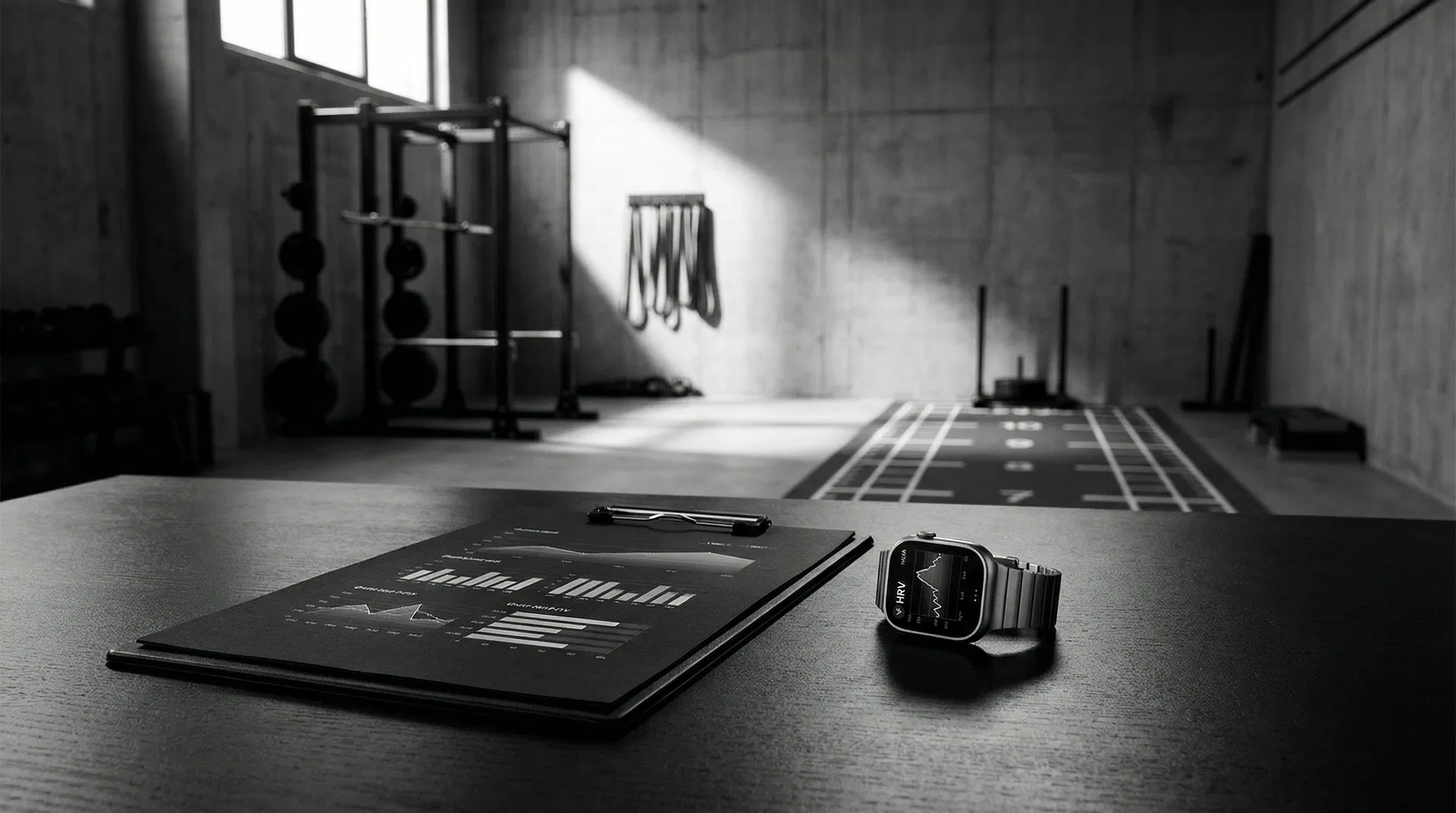
This is a fully online performance coaching service designed for people who want results without guessing. You complete the Performance Assessment. Based on your biology, lifestyle, and data, you receive a personalised, tailor-made program built on the same principles used to prepare Olympic athletes. No junk volume. No generic templates. Your WHOOP data (HRV, resting heart rate, respiratory rate, sleep architecture) is analysed weekly, and your program and protocols are adjusted to move every metric in the right direction. This article explains exactly what that $2,100 per month investment delivers.
The Problem This Solves
Mel Siff, one of the most respected minds in strength science, wrote in Supertraining:
To me, the sign of a really excellent routine is one which places great demands on the athlete, yet produces progressive long-term improvement without soreness, injury or the athlete ever feeling thoroughly depleted. Any fool can create a program that is so demanding that it would virtually kill the toughest marine or hardiest of elite athletes, but not any fool can create a tough program that produces progress without unnecessary pain.
That distinction captures the problem with most training programs on the market today.
Most founders and executives are training without a system. They follow random workouts from Instagram, hire a personal trainer who counts their reps, or buy a generic online program that was written for no one in particular. And here is the uncomfortable truth: unless you have worked with an experienced health and performance coach, there is a very high chance you have no idea what separates a good program from an average one.
Most people judge a program by exercise selection. How "creative" or "intense" the exercises look. How sore they feel the next day. How much they sweat. None of that tells you whether the program is actually making you better. Getting tired is easy. Getting better is a completely different skill.
A properly designed performance program is built on principles that most people have never been taught:
Movement quality: are you moving well before you move heavy? Are restrictions and asymmetries being addressed, or are you loading dysfunction and building toward injury?
Planes of motion balance: is your program training you across all three planes of movement (sagittal, frontal, transverse), or are you stuck in the same forward-and-back patterns that reinforce the postural damage from sitting at a desk all day?
Volume and intensity management: are you doing the right amount of work at the right intensity, or are you just accumulating volume for the sake of feeling busy? More is not better. Better is better.
Deload weeks: does your program include planned recovery periods that allow your nervous system to adapt and supercompensate, or does it just push harder every week until something breaks?
Loaded vs. unloaded movements: is there a deliberate balance between heavy loaded patterns and unloaded mobility, stability, and bodyweight work? This balance is what separates programs that build resilient bodies from programs that create injuries.
Progressive overload: is there a structured, measurable plan to increase load, volume, or complexity over time, or are you just doing random exercises at random weights and hoping for the best?
This is the difference between a program designed to make you better and a workout designed to make you tired. One is built by someone who understands periodisation, biomechanics, and the physiology of adaptation. The other is built by someone who knows how to make you sweat.
Why This Matters: The Bigger Picture
This is not just about training. It is about how you want to live for the next 30, 40, 50 years.
Longevity. The research is unambiguous: strength is the single greatest predictor of all-cause mortality as you age. Grip strength, leg strength, the ability to get up off the floor without using your hands. These are not gym metrics. They are survival metrics. A well-designed strength program is the closest thing we have to an anti-aging protocol.
Being strong. No one has ever regretted being strong. Not once. Strength makes everything in life easier. Carrying your kids. Travelling with luggage. Recovering from illness. Performing under pressure. Strength is not about aesthetics. It is about capacity, the capacity to handle whatever life demands of you.
Looking good and feeling healthy. When your training is structured correctly, when your sleep is optimised, when your recovery protocols are dialled in, the way you look and feel changes as a natural consequence. You do not need to chase aesthetics directly. You need to chase performance, and the aesthetics follow.
The goal of this program is to hit performance targets, not to get tired. Every session has a purpose. Every phase builds on the last. Every metric is tracked so you can see, in objective numbers, that you are getting better. That is the standard. That is what $2,100 per month buys you.
How It Works: The Client Journey
This is a fully online service. You do not need to live in Sydney. You do not need to train at a specific gym. You need a WHOOP band, access to a gym (any gym), and the willingness to follow a structured, evidence-based system.
Step 1: The Performance Assessment
Everything begins with the Performance Assessment. This is not a questionnaire. It is a comprehensive evaluation of your current physical capacity, your biology, and your lifestyle.
The assessment covers:
Movement quality: identifying restrictions, asymmetries, and injury risks. Most executives have significant hip flexor tightness, thoracic spine restrictions, and shoulder mobility deficits from years of sitting. These must be addressed before loading heavy movement patterns.
Strength baselines: establishing your numbers across fundamental movement patterns (squat, hinge, push, pull, carry). These become the objective benchmarks against which all future progress is measured. Every number is tracked using the Epley Formula to estimate your 1 rep max across every major lift.
Biometric baseline from WHOOP: your resting heart rate, heart rate variability (HRV), respiratory rate, sleep duration, sleep efficiency, deep sleep percentage, REM sleep percentage, and strain patterns. This tells us the current state of your nervous system, your recovery capacity, and where the biggest opportunities for improvement are.
Lifestyle context: your travel schedule, work demands, stress load, current nutrition habits, and training history. A program that ignores the reality of your life is a program that will fail.
This assessment is not a one-time event. It is repeated at regular intervals to track progress objectively and recalibrate the plan.
Step 2: Your Personalised Program
Based on the assessment, you receive a training program that is built specifically for your biology and your lifestyle. This is not a template. It is not a PDF that gets sent to every client. It is a program designed for one person: you.
Here is what makes it different from anything you have done before:
Zero junk volume. Every set, every rep, every exercise exists for a specific reason. If it does not serve your goals or your body's current capacity, it is not in the program. Most people are doing too much of the wrong things and not enough of the right things. This program corrects that.
Built for your biology. Your training age, injury history, movement restrictions, strength ratios, and recovery capacity all determine what goes into your program. A 45-year-old founder with a desk-bound lifestyle and a history of lower back pain requires a fundamentally different approach than a 30-year-old former athlete.
Structured periodisation. Training is organised into phases, typically 4 to 6 week blocks, with specific objectives. Hypertrophy. Strength. Power. Conditioning. Each phase builds on the previous one. Nothing is random.
Adapted to your schedule. If you travel two weeks per month, the program accounts for hotel gyms, jet lag, and disrupted routines. If you have board meetings every Monday, heavy deadlifts are not programmed for Sunday evening. The program fits your life, not the other way around.
Progressive overload, tracked objectively. Every training block builds on the previous one. Weights increase, volume adjusts, and complexity progresses in a structured, measurable way. Your estimated 1RM is tracked across every major lift so we can see, in real numbers, whether you are getting stronger. No guessing.
Step 3: WHOOP Data Analysis
This is where this service diverges most sharply from anything else available. Your WHOOP data is not just collected. It is analysed, interpreted, and used to make real-time decisions about your training and recovery.
Every week, I review your WHOOP data across these key metrics:
Heart Rate Variability (HRV): the single most reliable indicator of your nervous system's readiness. A declining HRV trend tells us you are accumulating stress faster than you are recovering from it, often before you feel any symptoms. When HRV drops, we adjust training load, recovery protocols, or both.
Resting Heart Rate (RHR): tracked alongside HRV to build a complete picture of autonomic nervous system function. A rising RHR trend signals incomplete recovery, illness onset, or excessive training load.
Respiratory Rate: a subtle but powerful indicator of systemic stress and recovery status. Changes in respiratory rate during sleep often precede changes in HRV and RHR, giving us an early warning system.
Sleep Architecture: not just how long you sleep, but how well. We track deep sleep, REM sleep, and sleep efficiency. Poor sleep architecture undermines every other investment you are making in your performance. When the data shows a problem, you receive specific protocols to fix it.
Strain vs. Recovery Balance: your daily strain score relative to your recovery score determines whether you should push harder, maintain, or pull back. This is how Olympic athletes periodise their training, and it works equally well for executives.
The goal is simple: get every metric trending in the right direction. When HRV is climbing, RHR is dropping, sleep quality is improving, and strain is being managed intelligently, the results in the gym, in your energy levels, and in how you look and feel follow automatically.
Step 4: Protocols That Move the Numbers
Based on what the data reveals, you receive specific, actionable protocols. These are not generic tips from a podcast. They are targeted interventions based on your data.
If your HRV is chronically low: you receive a breathing protocol (specific cadence, duration, and timing), guidance on training load reduction, and sleep environment adjustments designed to shift your nervous system toward parasympathetic dominance.
If your deep sleep is insufficient: you receive a temperature protocol, a light exposure schedule, and a pre-sleep routine calibrated to your specific sleep data and lifestyle constraints.
If your RHR is trending upward: we reduce training volume, increase Zone 2 cardio, and implement active recovery sessions until the trend reverses.
If your respiratory rate is elevated: this often signals the early stages of illness or accumulated fatigue. We proactively reduce load before it becomes a problem.
Every protocol is designed to create a measurable change in your data within 2 to 4 weeks. If it does not, we adjust. The data tells us what is working and what is not. There is no guessing.
What This Looks Like in Practice: Sam's Story
Sam is a 49 year old professional. She started this program in February 2024 with no structured training history and a body that had been neglected through years of prioritising work over health. Two years later, here is where she stands.
0 WORKOUTS 0 PHASES 0.0 SESSIONS / WEEK 0% COMPLETION RATE
Not random gym sessions. 329 structured, periodised, purposeful training sessions across 20 programmed phases. From her first hypertrophy block through to max strength, wave loading, pyramid programming, and power phases. Every phase built on the one before it. Nothing was wasted. A 98.8% completion rate. That is not willpower. That is what happens when a program is designed to fit your life rather than fight against it.
Periodisation: The Architecture of Progress
Every phase has a purpose. Hypertrophy blocks build muscle. Strength phases test capacity. Wave loading and pyramid protocols challenge the nervous system. Deload weeks allow recovery and supercompensation. This is not random. This is a two year architecture of progressive adaptation.
20 PROGRAMMED PHASES OVER 2 YEARS
Hypertrophy Strength / Power Wave Loading Pyramid De-Load Strength Benchmarks: The Numbers That Matter
After 20 phases of structured programming, here is where Sam stands relative to her age, gender, and bodyweight. These are not beginner results dressed up with fancy language. These are objectively measured, progressively built, data verified outcomes.
STRENGTH BENCHMARKS AFTER 20 PHASES
2.4x
Deadlift to Bodyweight
ADVANCED
130kg / 54kg bodyweight
3.4x
Leg Press to Bodyweight
ELITE
182kg estimated / 54kg bodyweight
18 reps
Strict Chin Ups
ELITE
At 54kg bodyweight. Outstanding relative strength.
73.5 kg
Combined Grip Strength
ABOVE AVERAGE
Combined left and right hand grip
A 49 year old woman deadlifting 2.4 times her bodyweight. Performing 18 strict chin ups. Leg pressing at elite level.
What the Data Tells Us Next
The system does not just track where you are. It identifies exactly where to focus next. Every weakness is visible. Every opportunity is mapped. Nothing is left to guesswork.
IDENTIFIED FOCUS AREAS
HIGH ~24 months
Upper Body Pressing Strength
HIGH Ongoing
Grip Strength Asymmetry (Left vs Right)
MODERATE ~18 months
Push to Pull Ratio Rebalancing
MODERATE Recurring
Posterior Chain Resilience
This is what two years of structured, periodised, evidence based coaching produces. Not soreness. Not exhaustion. Progress.
What This Is Not
This is not personal training. You do not need someone standing next to you in a gym. You follow your program independently, with full support and communication available whenever you need it. The value is in the system, not the supervision.
This is not a quick fix. If you want to lose 10 kilograms in 30 days, this is not the right investment. Performance coaching operates on a longer time horizon because sustainable results require sustainable systems. Expect meaningful, measurable progress within 8 to 12 weeks, and transformative results within 6 to 12 months.
This is not a generic program. If a coach is charging $2,100 per month and giving you the same PDF template they give everyone else, you are being overcharged. The entire value proposition is individualisation based on your data.
This is not guesswork. Every decision is informed by objective data. Your WHOOP tells us what your body needs. Your training data tells us what is working. Your dashboard shows us the trend. We follow the evidence.
The ROI Calculation
Time efficiency. A structured program eliminates wasted training sessions. No more wandering around a gym wondering what to do. Every session has a purpose, a target, and a measurable outcome. Most clients report saving 3 to 5 hours per week compared to their previous unstructured approach, while getting significantly better results.
Cognitive performance. Improved sleep quality, optimised HRV, and consistent training have been shown to improve executive function, working memory, and decision-making quality. For someone whose decisions directly impact revenue, the cognitive dividend alone can justify the investment.
Reduced healthcare costs. Proactive health management prevents the reactive medical interventions that become increasingly common, and expensive, after 40. A $2,100 monthly investment in prevention is substantially less than the cost of a cardiac event, a back surgery, or the productivity loss from chronic fatigue.
Longevity of career performance. The average founder burns out within 3 to 5 years. A performance system extends your operating window by managing the physiological cost of sustained high output. You are not just performing better now. You are protecting your ability to perform for the next 20 years.
| INVESTMENT | MONTHLY COST | WHAT YOU GET |
|---|---|---|
| Premium gym membership | $200-400 | Access to equipment, no guidance |
| Personal trainer (2x/week) | $480-960 | Supervised exercise, minimal programming |
| Online coaching template | $100-300 | Generic program, no individualisation |
| Performance coaching | $2,100 | Performance Assessment, personalised programming, WHOOP data analysis, recovery protocols, performance dashboard, direct access |
| Executive health retreat (annual) | $5,000-15,000 | One week of intervention, no ongoing support |
How to Know If This Is Right for You
This service is designed for a specific type of person:
You are results-driven. You do not want to "try things and see what happens." You want a system that produces measurable outcomes.
You see $2,100 per month not as a cost but as an investment in the asset that drives everything else: your body and your brain. The highest performing founders understand that every dollar spent on health compounds over decades in energy, clarity, and career longevity.
You are willing to wear a WHOOP band and follow a structured program. This means trusting the data, following the plan, and making changes to your habits based on evidence rather than preference.
You have specific goals: building strength, improving energy, optimising sleep, increasing longevity, or simply performing at a level that matches your ambition.
You understand that health is a performance advantage, not a hobby. The best founders treat their body the way they treat their business: with strategy, measurement, and professional guidance.
Sam's 24-Week Results
Founder, 41 years old. Desk-bound 60+ hours/week. Here is what changed.
Foundation
Movement quality, sleep hygiene, baseline testing
Build
Progressive overload, nutrition protocols, HRV tracking
Perform
Peak strength, body composition targets, energy optimisation
Sustain
Habit automation, maintenance protocols, long-term system
The Bottom Line
This is a fully online performance system. You complete the Performance Assessment. You receive a program built for your biology, your lifestyle, and your goals. Your WHOOP data is analysed weekly and used to adjust everything in real time. Every metric is tracked. Every decision is based on evidence. Every protocol is designed to move your numbers in the right direction.
The same principles that prepare Olympic athletes for the highest level of competition apply directly to the demands of leading a company. The stress is different. The physiology is the same.
If you are ready to stop guessing and start seeing results backed by data, take the Performance Assessment to get started.
Want protocols like these, personalised for you?
Take the 2-minute performance assessment to see where you stand.
Take the Assessment